Optimizing Payment Terms: A Policy Playbook for a Bangalore-Based Creative Agency
A Bangalore-based creative agency often faces late payments. This guide outlines how clear payment terms and automated follow-ups can improve cash flow and client relations. Learn to set expectations and reduce payment delays.

As a creative agency in Bangalore, your focus is on delivering stunning designs, compelling campaigns, and innovative digital experiences. You pour your talent into client projects, turning visions into reality. But what happens after the project is delivered and the invoice is sent? For many agencies, this marks the beginning of another creative endeavor: crafting polite follow-up messages and navigating the often-awkward dance of payment collection.
Client payment delays are not just an inconvenience; they can directly impact your agency's ability to pay your team, invest in new software, or even take on new projects. Managing these delays often consumes valuable time that could be spent on billable work or business development. It's a common story: an invoice for ₹2,50,000 for a website redesign is due in 30 days. Day 31 passes, then day 45. Suddenly, you're not just a creative director but also a collections agent, delicately reminding a client about a payment that's already weeks overdue.
This article outlines a policy playbook for a Bangalore-based creative agency to optimize payment terms, set clear expectations, and leverage automation to ensure smoother cash flow and stronger client relationships.
Setting the Foundation: Clear Payment Terms from the Start
The most effective way to prevent late payments is to establish crystal-clear payment terms and communicate them unequivocally before work begins. This isn't just about stating "Net 30"; it's about outlining a comprehensive payment policy that leaves no room for ambiguity.
1. The Power of a Detailed Proposal & Contract
Your proposal and contract are your first line of defense. They should explicitly detail:
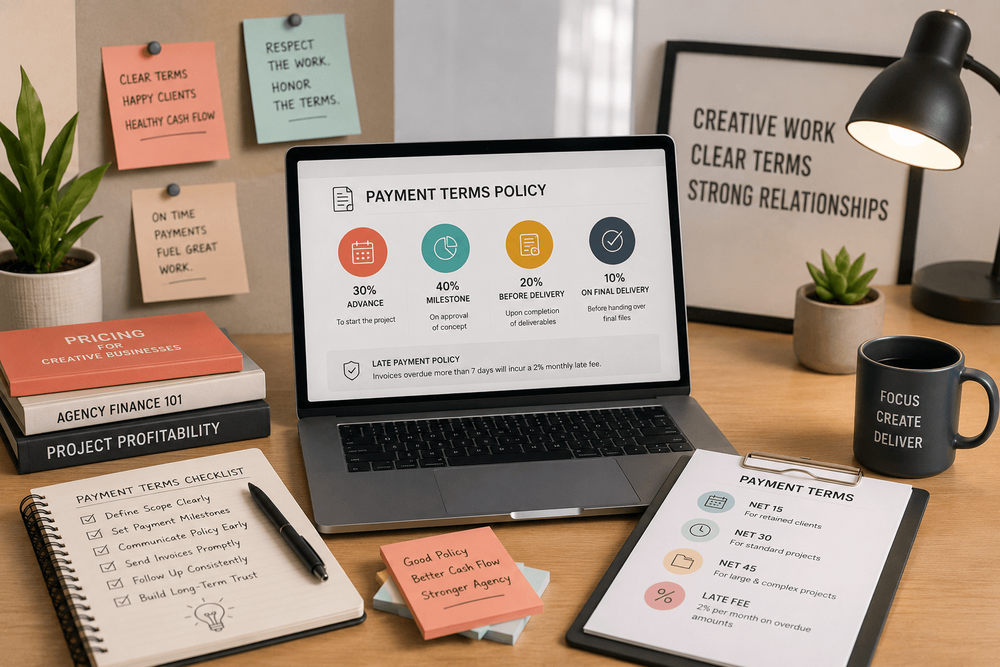
- Payment Milestones: For larger projects, break down payments into stages (e.g., 25% upfront, 25% at design approval, 25% at development completion, 25% upon launch). This reduces the risk of a large, single payment delay.
- Payment Due Dates: Clearly state the number of days within which payment is expected (e.g., "Payment is due within 15 days of invoice date" – consider shorter terms than Net 30 for smaller agencies).
- Accepted Payment Methods: Specify how clients can pay (bank transfer, UPI, etc.).
- Late Payment Policy: Outline what happens if payment is not received on time. This could include a simple late fee or a temporary pause in project work until payment is cleared. While not always enforced, its presence signals seriousness.
- Invoicing Schedule: Clarify when invoices will be sent (e.g., "Invoices for monthly retainers will be issued on the 1st of each month, due by the 15th").
"A well-defined payment policy in your contract isn't just a legal formality; it's a critical communication tool that sets client expectations and safeguards your agency's cash flow."
2. Upfront Deposits: A Game Changer
For new clients or large projects, requesting an upfront deposit (e.g., 25-50% of the project cost) is standard practice and highly recommended. This secures commitment from the client and provides initial working capital for your agency. It also acts as a filter, ensuring you're working with serious clients.
Streamlining the Invoicing Process
Once the terms are set, the actual invoicing process needs to be efficient and error-free. Using accounting software like QuickBooks is crucial for this.
1. Timely and Accurate Invoicing
- Invoice Promptly: Send invoices immediately upon project completion or milestone achievement. Delays in invoicing often lead to delays in payment.
- Clear Invoice Details: Ensure each invoice includes:
- Your agency's name, address, and GSTIN.
- Client's name, address, and GSTIN.
- Unique invoice number.
- Date of invoice and due date.
- Detailed breakdown of services rendered and corresponding costs.
- Total amount due in ₹.
- Payment instructions.
2. Integrating with QuickBooks
For a Bangalore-based agency, QuickBooks integration streamlines your entire billing workflow. When you create an invoice in QuickBooks, it's ready for dispatch. This also centralizes your financial data, making it easier to track outstanding payments.
The Art of Follow-Up: From Manual to Automated
Even with the clearest terms and timely invoices, some payments will inevitably be late. This is where your follow-up strategy comes into play. The goal is to be persistent without being pushy, and professional without being cold.
1. Crafting Effective Reminder Messages
Here's a framework for a series of escalating, yet polite, reminders:
-
Pre-Due Date Reminder (3-5 days before): A gentle heads-up. Often prevents late payments by catching clients before they forget.
- Subject: Reminder: Upcoming Payment for Invoice [Invoice Number] - [Client Name]
- *Body: "Hi [Client Name], just a friendly reminder that Invoice [Invoice Number] for ₹[Amount] is due on [Due Date]. You can view the invoice here: [Link to Invoice]. Please let us know if you have any questions."
-
Due Date Reminder (On Due Date): A direct but polite notification.
- Subject: Invoice [Invoice Number] - Payment Due Today
- *Body: "Hi [Client Name], this is a reminder that payment for Invoice [Invoice Number] (₹[Amount]) is due today, [Due Date]. You can find the invoice details here: [Link to Invoice]. Please confirm when we can expect payment."
-
Post-Due Date Reminder (3-5 days overdue): The first official 'overdue' notice, still polite.
- Subject: Action Required: Overdue Invoice [Invoice Number] - [Client Name]
- *Body: "Dear [Client Name], our records indicate that Invoice [Invoice Number] for ₹[Amount], due on [Due Date], is still outstanding. We would appreciate it if you could process this payment at your earliest convenience. Here is the invoice again for your reference: [Link to Invoice]. Please let us know if there has been any issue or if payment has already been sent."
-
Escalated Reminder (10-15 days overdue): More firm, hinting at contract terms.
- Subject: Follow-up: Overdue Payment for Invoice [Invoice Number] - [Client Name]
- *Body: "Hi [Client Name], we are following up regarding Invoice [Invoice Number] for ₹[Amount], which is now [Number] days overdue since [Due Date]. As per our agreed terms, we kindly request immediate payment to avoid any disruption to ongoing services or the application of late fees. Please contact us to resolve this as soon as possible. Invoice link: [Link to Invoice]."
2. The Power of WhatsApp Messaging
In the Indian business context, WhatsApp is an indispensable communication tool. Short, clear WhatsApp messages can be highly effective for payment reminders, especially for initial nudges.
- Pre-Due: "Hi [Client Name], just a reminder that Invoice [Invoice Number] for ₹[Amount] is due on [Due Date]. Please find the invoice here: [Link]. Thank you!"
- Overdue: "Hi [Client Name], following up on Invoice [Invoice Number] for ₹[Amount], which was due on [Due Date]. Could you please advise on its status? Invoice link: [Link]."
3. Automating Your Follow-Ups
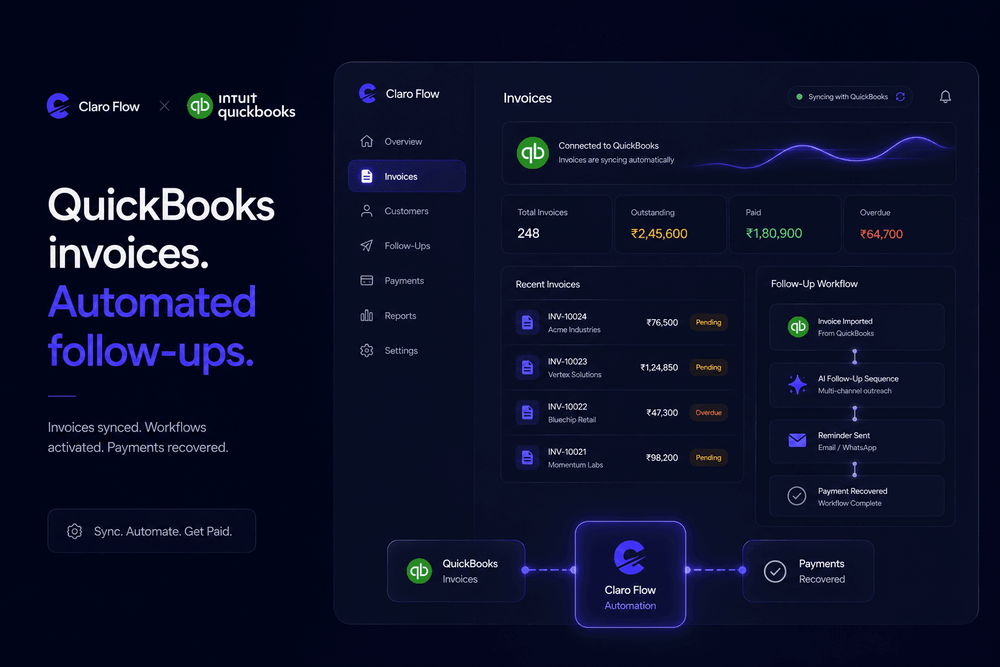
Manually tracking and sending these reminders for every client is a massive time sink. This is where automation becomes invaluable for a creative agency. Tools like Claro Flow integrate directly with QuickBooks.
Instead of checking spreadsheets and drafting individual messages, you can set up automated cadences:
- Define a sequence of email and WhatsApp reminders based on specific triggers (e.g., 5 days before due, on due date, 3 days overdue, 10 days overdue).
- The system automatically sends these reminders, complete with payment links, without you lifting a finger.
- You get notified when a client views an invoice or makes a payment, keeping you informed without constant manual checking.
By leveraging automation, your Bangalore-based creative agency can ensure consistent follow-up, reduce the administrative burden on your team, and maintain a professional tone throughout the collections process.
Handling Specific Client Scenarios
Sometimes, late payments stem from specific issues. A proactive approach can help resolve them quickly:
- 'Invoice Not Received': Always send invoices via email with a read receipt if possible, and have a system that confirms delivery. With automation, you can track if an invoice has been viewed.
- 'Payment Sent, Check is in the Mail': Politely request a transaction ID or proof of payment. If the payment method is digital, this excuse becomes less valid.
- 'Budget Freeze/Delay': Understand the situation. If it's a genuine temporary issue, discuss a revised payment plan. Document any new agreements in writing.
Conclusion: Chase Nothing, Create Everything
For a creative agency in Bangalore, time is best spent on what you do best: creating. By implementing clear payment policies, leveraging detailed contracts, and automating your invoice follow-up process, you can significantly improve your agency's cash flow and reduce the stress associated with collections. No more awkward conversations or endless manual tracking. Instead, your team can focus on delivering exceptional creative work, knowing that your payment reminders are handled professionally and automatically.
Claro Flow helps you achieve this by integrating with your QuickBooks account and sending polite, timely email and WhatsApp reminders. It transforms a tedious, time-consuming task into a streamlined, automated process, allowing your creative agency to truly "Chase Nothing, Create Everything" and dedicate your energy to your craft.